SUSTAINABLE CITY CLUSTER

Technopole Cité Descartes: Supporting the City and Digital, Sustainable Regions
Paris, the global capital of sustainable innovation
The Descartes Technology Park, located in the inner suburbs of Paris, has established itself as a driving force for transformation for companies, startups, and institutions seeking to shape the city of tomorrow. Situated at the heart of an ecosystem rich in talent, infrastructure, and opportunities, this technology park fosters co-innovation, applied research, and economic development.
This article offers a comprehensive exploration of the role, benefits, and prospects offered by a technology park in the Paris region: its definition, how it operates, concrete examples, and the strategic reasons for establishing a presence there.
The Strategic Role of Technology Parks in Innovation and the Economy
Accelerated R&D
The Descartes Technopole has a roadmap to foster innovation and is a University Innovation Hub (PUI) for Health, Environment, and Urban Development.
Startup Catalyst
A member of the Retis network of French technology parks, an innovation cluster, EU-BIC-certified, and recognized by regional, national, and European authorities
Public-Private Partnership
Higher education and research, industry-sponsored chairs, major corporations, SMEs, and startups (deep tech) are the driving forces behind the technology park.
Regional Development
Cité Descartes has established itself as a “venture builder” in the fields of urban innovation and ecological transition.
What is a technology park?
A technology park is a strategic innovation hub that brings together companies, research laboratories, universities, incubators, and public sector entities to promote technology transfer and foster the growth of startups and innovative SMEs. In Paris and the Île-de-France region, technology parks are built around thematic centers of excellence, such as sustainable cities, digital technology, healthcare, and deep tech.
Origins and Evolution of the Technopole Model
The concept of the technology park, which first emerged in the 1970s with Sophia Antipolis, has gradually spread throughout France. Today, Paris is a key international hub, thanks to large-scale projects such as Paris-Saclay, Station F, and Cap Digital. The technology park has become a globally recognized model for regional economic development.
Difference between a cluster, a competitiveness cluster, and a technology park
- Cluster: a grouping of companies and stakeholders in the same sector (industry) within a given region
- Competitiveness cluster: a government-certified grouping that brings together companies, research institutions, and educational institutions around innovation (example: Systematic Paris-Region)
- Technology park: a broader regional ecosystem that integrates clusters, incubators, research laboratories, public support programs, and local governments, fostering interactions to create an environment conducive to innovation
Cité Descartes by the Numbers
Institutions
Cité Descartes, the heart of the Paris-Est Technopole, accounts for a quarter of France’s research on sustainable cities
Current Trends at the Heart of the DESCARTES Technopole
The priorities of Descartes Développement & Innovation, the operator of the Technopole, address the technological and environmental challenges of the 21st century:
- Artificial intelligence and deep tech: development of AI solutions applied to energy management and urban optimization
- Smart cities: use of data to optimize urban traffic flows, mobility, and public services
- Digital security and resilience: protecting critical infrastructure and securing sensitive urban data
- Funding: access to national and European programs to support collaborative research and deep tech startups
The Descartes Technopole stands out by integrating these trends into a vision of a sustainable city and an ambitious ecological and digital transition.
Territorial and Political Dimensions: Support for Technology Parks
The Descartes Technology Park does not operate in isolation. It is part of a strong institutional framework:
- Through the France 2030 Plan, the French government is directing 54 billion euros toward innovation, a significant portion of which benefits stakeholders in technology parks.
- The Île-de-France Region invests tens of millions of euros each year in regional innovation ecosystems.
- The European Union funds collaborative projects through programs such as Horizon Europe and the European Regional Development Fund (ERDF).
Descartes Développement et Innovation, together with its partners in the technopole, acts as a strategic link between startups, SMEs, research labs, and these public funding mechanisms.
Notable examples of technology parks
- Sophia Antipolis: a pioneering European technology park founded in 1969, the first of its kind in France
- Angers Technopole: digital and plant-based innovation on a regional scale
- Atlanpole: supporting innovative companies in the fields of digital technology, healthcare, marine industries, and manufacturing
- Global technology hubs: Montreal (information technology), Barcelona (smart city), Shenzhen (electronics and hardware)
Why set up your business in a technology park near Paris?
A vibrant innovation ecosystem
Immediate synergies with universities, public and private research laboratories, industry clusters, and major industrial groups.
Funding and Support
Access to incubators, assistance with fundraising, public funding (BPI, regional government, EU), and accelerator programs.
Accelerated Technology Transfer
Leveraging patents, access to state-of-the-art research equipment, and applied research to accelerate time to market.
Professional Networks and Outreach
Expanding opportunities through trade shows, industry events, European programs, and international collaborations led by the technology park.
At Descartes Développement et Innovation, we help Technopole users start businesses, innovate, grow, recruit, train their staff, and establish operations by providing them with industry expertise, a network of qualified professionals, and personalized support at every stage of their project.
The Challenges and Limitations of the Technopole Model
While technology parks are powerful drivers of economic development, they also raise structural challenges that must be identified and anticipated to ensure a sustainable and inclusive model.
Geographic Concentration and Territorial Divisions
The concentration of technology parks in urban areas creates a risk of regional inequalities. This polarization of innovation exacerbates imbalances between regions: while some attract talent, investment, and research infrastructure, more rural areas may struggle to develop their own innovation ecosystem.
This phenomenon has several consequences: a brain drain to major cities, difficulty accessing funding for startups and SMEs located outside technology parks, and a widening gap in economic development. To address this, certain initiatives are emerging, such as community-based technology parks or regional “third places” for innovation, aimed at fostering innovation across the entire country.
International Competition and the War for Talent
The proliferation of technology parks and clusters worldwide has intensified competition to attract top talent and strategic investments. Faced with ecosystems such as Silicon Valley, Shenzhen, Tel Aviv, and Singapore, European technology parks and clusters must continually enhance their appeal.
To remain competitive, technology parks like Descartes are capitalizing on their unique strengths: strong sector-specific specialization (sustainable cities, smart cities), high-quality support services, privileged access to financing, and positioning in high-value-added niche markets.
Sustainability and Digital Responsibility
Paradoxically, technology parks that promote innovation must themselves reinvent their business models in the face of climate and societal challenges. The digital sector’s carbon footprint, data centers’ energy consumption, land development, and the production of electronic waste raise questions about consistency.
Modern technology parks now incorporate requirements for digital sustainability: optimization of IT infrastructure, use of renewable energy, eco-design of products developed by startups, the circular economy, and equipment recycling. The Descartes Technology Park has made the digital and sustainable city its core mission, prioritizing support for projects that meet the Sustainable Development Goals as defined by the United Nations.
News & Events
 04 February 2026
Rejoignez le programme d’accélération FEDER 2025-2027 de Descartes Développement & Innovation et propulsez votre startup ou PME vers le succès ! 🚀
💡 Vous avez un projet innovant ? Nous avons les clés pour l’accélérer ! Vous…
 14 January 2026
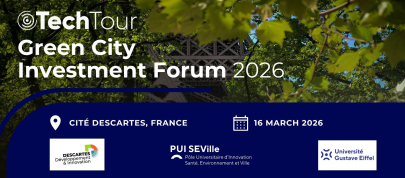
Tech Tour GreenCity 2026 : Forum d’investissement
Tech Tour GreenCity 2026 : L’Innovation Urbaine et Durable au Cœur de l’Investissement 📍Lieu :…
FAQ – Descartes Technology Park
An incubator provides space and support for startups during their seed phase. A technology park goes a step further: it brings together incubators, clusters, research laboratories, institutions of higher education, local governments, and large companies within a single, cohesive regional ecosystem.
There are more than 40 active technology parks in France, some of which are located in the Île-de-France region. Each technology park focuses on a specific sector (healthcare, digital technology, engineering, agri-food, etc.).
Startups and companies can apply through incubation programs, public calls for proposals, partnerships with innovation hubs, or directly to the technology park’s management organizations.
Bpifrance, European funds (Horizon Europe, ERDF), business angels, venture capital, corporate investment funds, and industrial partnerships are the main sources of financing available through a technology park.
In addition to Paris-Saclay and Sophia Antipolis in France, other examples include Silicon Valley (United States), Shenzhen (China), Technoparc Montréal (Canada), Cambridge Science Park (United Kingdom), and Barcelona Tech City (Spain).
The Descartes Technopole in Eastern Paris: A Strategic Choice for Innovation
By 2030, the Descartes Technopole, located within the Greater Paris region, aims to be recognized as the leading center for innovation in the Île-de-France region, serving the sectors that will shape the cities and regions of tomorrow.
A hub for collaboration, equipped with resources (incubator, fablab, cluster, university innovation hub) to foster projects between businesses, local governments, and research institutions, thereby developing business relationships
With its heart at Cité Descartes: proximity to the capital, accessibility, green spaces, access to excellence, and the ability to attract top talent.
A true crossroads between academic research, innovative entrepreneurship, and public-private funding, this technopole embodies the future of sustainable and smart cities.
Joining the Descartes Technology Park means becoming part of a unique ecosystem that is shaping a new generation of projects combining cutting-edge technology, environmental sustainability, and inclusive economic development. The technology park offers an ideal environment to accelerate your ambitions and actively contribute to building the city of tomorrow.